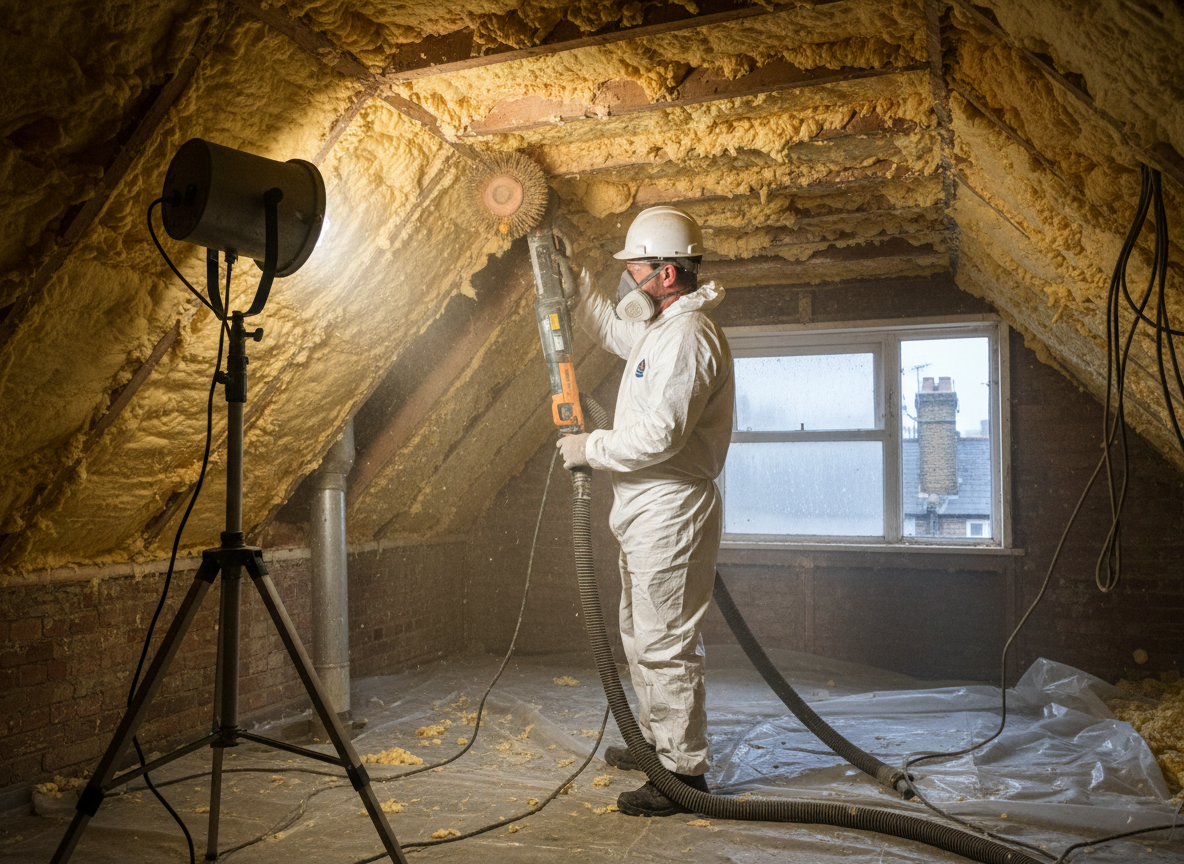
London's Victorian terraces in neighbourhoods such as Islington and Camden often received spray foam insulation decades ago that now traps moisture against brickwork. Removing it requires cutting through multiple layers while protecting lath and plaster ceilings that sit directly below. Winter rain and high humidity accelerate mould growth once the foam is disturbed, so crews seal off sections immediately and ventilate through existing chimney flues.
Post-war flats in areas like Southwark and Tower Hamlets frequently used closed-cell foam in flat roofs. The material bonds tightly to concrete decks, and careless removal can breach waterproofing. Technicians test adhesion on small patches first, then use low-pressure scrapers and HEPA-filtered vacuums to limit dust that would otherwise settle into neighbouring properties across shared party walls.
Edge cases arise in converted mews houses around Kensington where foam fills original timber joists. These joists can be undersized by modern standards, so removal crews install temporary props before cutting. Any remaining residue must be neutralised because residual isocyanates react with the damp London clay soil conditions that keep basements persistently humid.
Regulatory checks focus on waste classification under Environment Agency rules for Greater London. Foam offcuts are double-bagged on site and taken to licensed transfer stations rather than general skips. Homeowners receive a waste transfer note that records the exact volume removed from each property.
Technician insight
In London, the thing that catches most people out with 24/7 Spray Foam Removal is how Victorian terraces in places like Camden have foam bonded directly to original lath and plaster; one wrong cut and you lose the ceiling below, and the damp clay soil keeps everything humid so mould appears within hours if you don't ventilate straight away.
Loft foam removal in a Southwark terrace
Homeowner reported persistent damp patches after recent heavy rain. Inspection found closed-cell foam filling the entire loft void above a 1930s terrace. Crew installed props, extracted the foam in sealed sections, and cleared residue from joists. Property dried out without further ceiling damage once ventilation was restored through existing roof vents.
How it works
- 1
Initial Site Assessment
Technician inspects loft or wall cavities in the London property, noting foam type, depth, and any hidden timber or pipework.
- 2
Containment Setup
Dust barriers and negative-pressure units are installed to protect adjacent rooms and neighbouring homes in terraced streets.
- 3
Foam Extraction
Material is cut and vacuumed in sections, with temporary supports added where joists risk movement in older stock.
- 4
Clearance and Documentation
Area is cleaned, waste is removed to licensed facilities, and the homeowner receives a transfer note plus photos of the cleared space.
Pricing
Upfront quotes after inspection; final cost depends on access, foam depth, and property type.