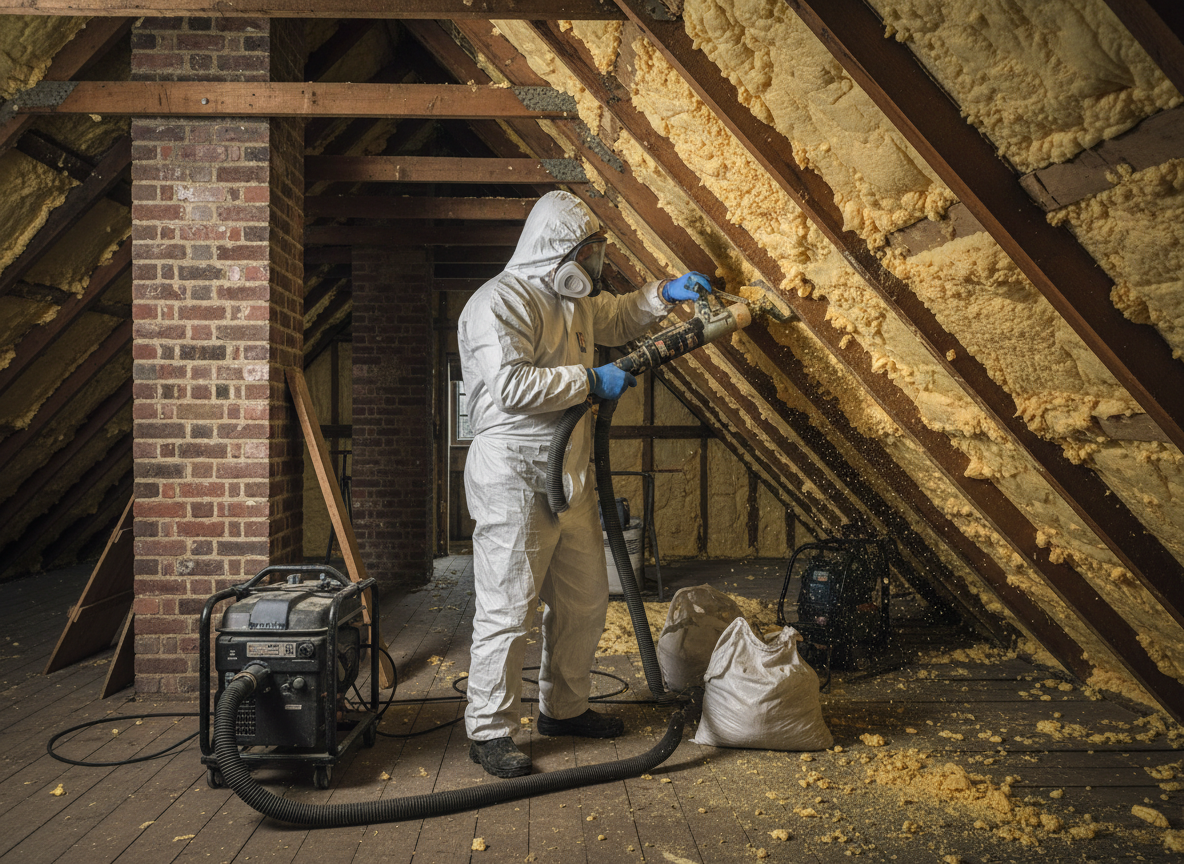
Closed cell spray foam bonds tightly to timber joists and brickwork in London’s Victorian and Edwardian terraces. Once installed it often traps moisture against original lath and plaster or roof felt, leading to rot and reduced ventilation in the humid London climate. Removal requires careful cutting in small sections to avoid disturbing asbestos-containing materials common in pre-1980s properties around Islington, Camden and Hackney.
Edge cases arise in mews houses and converted warehouses near the Thames where foam was applied over uneven surfaces or around steel beams. These installations demand extra containment because dust can migrate through party walls shared with neighbouring properties. Operators must also account for limited headroom in many central London lofts and the need to protect historic cornices during extraction.
After foam is stripped, restoring airflow is critical. London Building Control frequently requires new ventilation paths in older roofs to meet current moisture-control standards. Leaving residual foam or failing to clear debris can cause ongoing condensation problems that only appear during the city’s wet winters.
Disposal follows Environment Agency rules for construction waste; closed cell material is bulky and must be transported from tight central London sites using smaller vehicles to reach licensed facilities outside the congestion zone.
Technician insight
In London, the thing that catches most people out with closed cell spray foam removal is the irregular roof structures in Victorian terraces around areas like Islington and Camden. The foam often fills every gap between rafters, so you cannot simply peel it away without risking damage to century-old timbers or leaving hidden pockets that later cause damp.
Islington Victorian Terrace Loft
Homeowner reported persistent mould in a top-floor bedroom of a 1890s terrace. Inspection found closed cell foam fully adhered to rafters and trapping moisture against the original felt. We cut the foam into manageable sections, protected the historic timbers, extracted all material and restored ridge ventilation. Condensation issues resolved within weeks.
How it works
- 1
Site Assessment
Inspect loft or wall cavities in the London property, identify foam type and note any asbestos risk or structural concerns.
- 2
Containment Setup
Seal work areas with sheeting to prevent dust migration through party walls common in terraced housing.
- 3
Mechanical Removal
Cut and peel foam in controlled sections, protecting original timbers and roof felt during extraction.
- 4
Clearance and Disposal
Remove all debris, vacuum residues and transport waste to licensed facilities outside the congestion zone.
- 5
Ventilation Restoration
Reinstate or improve airflow paths to prevent future condensation issues in the London climate.
Pricing
Pricing depends on access, depth of foam and whether original timbers need protection in older London stock.